Remote-controlled antenna technology helps AIS explore more flexible ways to optimize coverage, reduce site visits and support temporary network deployments
Mobile networks need to continuously adapt as customer demand, traffic patterns and deployment conditions change. However, adjusting the direction of a conventional antenna typically requires technicians to physically access the site—making the process more challenging, time-consuming and costly, particularly at locations with restricted access.
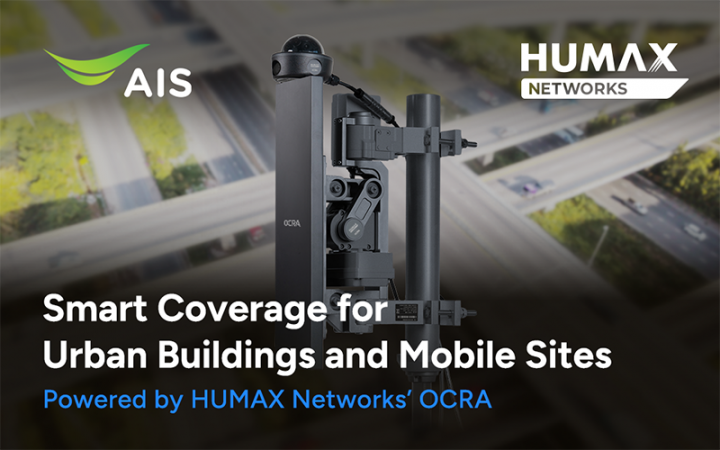
HUMAX Networks’ OCRA (Optical Compass & Robotic Arm) technology offers AIS another way to approach this challenge by enabling the direction of an antenna to be adjusted remotely.
AIS is exploring OCRA across several practical network scenarios, including challenging urban buildings and Mobile Base Station Car deployments in Bangkok. These evaluations are helping AIS assess how remote antenna control could provide greater flexibility in network planning, coverage optimization and temporary network deployment.
Remote antenna adjustment for hard-to-access buildings
Some buildings present unique challenges for network deployment and maintenance. Adjusting the antenna's orientation typically requires prior permission to access the site. This process may involve formal authorization, coordination with building management, and additional access procedures.
In existing environments, the ability to adjust antenna direction remotely can provide significant operational flexibility.
With HUMAX Networks’ OCRA, AIS can remotely position the antenna toward the required coverage area. For example, at a building where one antenna sector needs to serve a specific or priority area, the antenna direction can be adjusted without requiring technicians to repeatedly access the antenna location.
This approach can help AIS optimize coverage while reducing the need for physical intervention at difficult-to-access sites.
AIS is also evaluating similar requirements for buildings located along Bangkok's sky train lines, where restricted access and complex urban environments can make conventional antenna adjustments more challenging.
Bringing remote control to Mobile Base Station Car
AIS is also evaluating OCRA for Mobile Base Station Car deployments, where speed, flexibility and operational efficiency are particularly important.
As part of a demonstration project in Bangkok, OCRA units are installed on each Mobile Base Station Car, allowing the antenna sections to be remotely adjusted according to deployment requirements.
The evaluation is looking beyond antenna positioning alone. AIS and HUMAX Networks are also assessing the long-term reliability and durability of cables, equipment and accessories under mobile deployment conditions.
Mobile Base Station Cars can provide temporary network support for a range of situations, including:
• High-capacity public events
• Temporary coverage requirements
• Rapid network deployment and emergency response
• Dynamic coverage optimization
• Network testing and optimization
If the evaluation demonstrates satisfactory performance and durability, AIS could consider expanding the solution to additional areas and applications.
From temporary testing to permanent optimization
One potential advantage of OCRA is the ability to test and identify the optimum antenna direction before committing to a permanent installation.
Operators can remotely evaluate different antenna directions to determine which configuration best meets the coverage requirements of a particular location. Once the optimum position has been identified, the antenna can then be permanently installed in the selected direction.
This approach could help AIS optimize existing infrastructure before deciding whether additional antennas or other network investments are required.
In certain deployments, OCRA can also potentially be removed and reused at another site, providing additional flexibility during network planning, testing and deployment.
Reducing the need for physical site visits
Traditional antenna adjustment can require technicians to physically access antenna structures. At difficult or restricted locations, each site visit can require additional planning, coordination, time and operational resources.
Remote antenna positioning provides an alternative approach.
With OCRA, antenna direction can be adjusted remotely, potentially reducing unnecessary site visits while providing a more consistent and repeatable method of antenna positioning.
This capability can be particularly valuable for buildings with restricted access, temporary network deployments and other locations where physical intervention is inconvenient or operationally challenging.
Making antennas more responsive to changing demand
Mobile network demand is constantly changing.
A location that requires high capacity during the daytime may have different coverage requirements at night. Public events, traffic conditions and changes in user behavior can also shift where network capacity is needed.
Remote antenna positioning creates the possibility of more dynamic coverage optimization.
Looking ahead, antenna direction could potentially be scheduled or controlled according to changing traffic patterns—for example, prioritizing high-density areas during peak periods and adjusting coverage as demand moves.
When combined with network management and optimization platforms, this capability could help transform the antenna from a largely fixed network component into a more flexible and responsive network asset.
Complementing existing network management systems
OCRA is designed to complement existing network management capabilities.
Modern EMS platforms provide operators with extensive network monitoring and configuration functions. OCRA adds another layer of physical antenna control and visual monitoring, enabling operators to remotely understand and adjust antenna positioning when required.
Rather than replacing existing EMS platforms, OCRA can work as an additional tool within the operator’s broader network optimization environment.
This combination of network intelligence and remote physical control can provide greater flexibility in managing coverage across different deployment scenarios.
Exploring future applications
AIS and HUMAX Networks are also exploring potential future applications for OCRA.
Highway infrastructure represents one potential long-term opportunity. As new highway projects are developed in Thailand, AIS can assess future coverage requirements and determine whether additional antenna deployment or capacity optimization may be needed.
Emergency and disaster-response scenarios could also benefit from remotely adjustable antennas. When coverage requirements change rapidly, the ability to redirect an antenna without immediately sending a technician to the site could provide valuable operational flexibility.
These applications demonstrate how remote antenna control could potentially support both planned network expansion and rapidly changing coverage requirements.
Toward more intelligent and adaptive networks
The development of 5G and future network technologies is creating new opportunities to make telecommunications networks more automated, flexible and responsive.
Remote antenna control is one part of this evolution.
By combining remote antenna positioning, visual monitoring, network data and intelligent optimization, operators can move toward networks that respond more quickly to changing coverage requirements while making more effective use of existing infrastructure.
For AIS, the ongoing evaluation of HUMAX Networks’ OCRA demonstrates how practical antenna automation can address real-world network challenges—from difficult-to-access buildings to temporary Mobile Base Station Car deployments.
HUMAX Networks will continue working with AIS and telecommunications partners to explore how OCRA can help make mobile networks more flexible, efficient and responsive to the evolving needs of customers.
2026-11-03